 Department of Civil Engineering
Author: Mr. Aditya Mishra
Introduction: Engineering That Shapes Civilisation
Every road we travel, every bridge we cross, every skyscraper that touches the skyline, and every dam that powers cities stands as a testament to the impact of civil engineering. Among all engineering disciplines, B.Tech in Civil Engineering is one of the oldest, most respected, and most socially significant fields. It is not merely about constructing structures; it is about shaping sustainable communities, improving quality of life, and developing infrastructure that drives national and global development.
Civil engineering is widely regarded as the backbone of infrastructure development because it directly influences transportation systems, housing, water supply, environmental protection, disaster resilience, and urban planning. As populations grow and urbanisation accelerates, the demand for skilled civil engineers continues to rise steadily.
A B.Tech. in Civil Engineering equips students with the technical knowledge, practical skills, and innovative mindset required to design, construct, manage, and maintain infrastructure that serves society for generations. It is a discipline where creativity meets science, and engineering meets sustainability.
Why Choose B.Tech Civil Engineering?
Civil engineering extends far beyond bricks, steel, and concrete. It is a multidisciplinary field that integrates mathematics, physics, environmental science, management principles, and modern technologies such as Artificial Intelligence (AI), Geographic Information Systems (GIS), Building Information Modelling (BIM), drone surveying, and smart construction systems.
Choosing civil engineering means choosing a career that:
- Builds cities and communities
- Solves real-world infrastructure challenges
- Contributes directly to national development
- Offers diverse and evolving career opportunities
- Provides strong global employment prospects
- Combines fieldwork with technological innovation
The Diverse World of Civil Engineering
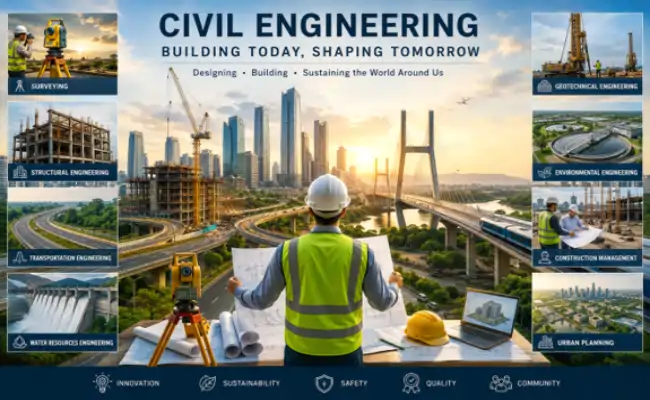
One of the greatest strengths of civil engineering lies in its diversity. The discipline covers multiple specialised areas, each essential to infrastructure development.
- Structural Engineering – Creating Safe and Strong Structures
Structural engineering forms the core of civil engineering. It focuses on designing buildings, bridges, flyovers, stadiums, towers, and industrial structures capable of resisting loads and environmental forces.
Students study:
- Structural analysis
- Reinforced cement concrete (RCC)
- Steel structures
- Prestressed concrete
- Earthquake-resistant design
Modern structural design relies on advanced software such as ETABS, STAAD Pro, SAP2000, and BIM tools to ensure safety, efficiency, and cost-effectiveness.
- Surveying – The Foundation of Every Project
No construction begins without surveying. It provides accurate measurements of land, elevations, boundaries, and terrain features.
Tools used include:
- Total stations
- Auto levels
- Differential GPS
- Drone mapping systems
- Laser scanners
- GIS applications
Surveying is essential for highways, railways, urban planning, mining, and smart city development.
- Transportation Engineering – Connecting People and Economies
Transportation engineering focuses on designing safe and efficient transport systems, including highways, railways, airports, metro networks, and urban roads.
Key areas include:
- Traffic engineering
- Pavement design
- Transportation planning
- Intelligent transport systems
This branch plays a vital role in reducing congestion and improving mobility in rapidly growing cities.
- Geotechnical Engineering – Engineering from the Ground Up
Geotechnical engineering studies soil and rock behaviour to ensure stable foundations for structures.
Topics include:
- Soil mechanics
- Foundation engineering
- Slope stability
- Ground improvement techniques
It ensures the safety and durability of buildings, bridges, tunnels, and dams.
- Environmental Engineering – Building Sustainably
Environmental engineering focuses on protecting natural resources and promoting sustainable development.
It includes:
- Water and wastewater treatment
- Solid waste management
- Air pollution control
- Environmental impact assessment
This branch is increasingly important in addressing climate change and promoting greener cities.
- Water Resources Engineering – Managing a Vital Resource
Water resource engineering deals with the planning and management of water systems.
Students study:
- Hydrology
- Hydraulic engineering
- Dam and canal design
- Irrigation systems
- Flood control structures
Efficient water management is crucial in the face of climate variability and population growth.
- Construction Engineering and Management – Turning Plans into Reality
This branch combines technical knowledge with management skills to execute large-scale projects.
Key areas include:
- Project planning and scheduling
- Cost estimation
- Contract management
- Construction safety
Software tools such as Primavera, MS Project, AutoCAD, Revit, and BIM platforms are widely used.
- Urban Planning and Smart Cities
Urban planning focuses on developing sustainable and liveable cities.
Civil engineers contribute to:
- Smart city development
- Affordable housing
- Green infrastructure
- Disaster-resilient urban systems
Modern tools such as IoT, GIS, and digital twins are transforming urban development.
Technology Transforming Civil Engineering
Civil engineering today is highly digital. Modern curricula include exposure to:
- Building Information Modelling (BIM)
- Artificial Intelligence and Machine Learning
- Drone surveying
- Remote sensing and GIS
- 3D printing in construction
- Smart sensors and IoT systems
- Robotics in construction
These technologies improve accuracy, reduce costs, and enhance project efficiency.
Practical Learning: Beyond the Classroom
Civil engineering education is strongly practice-oriented. Students engage in:
- Laboratory experiments
- Survey camps
- Site visits and industrial training
- Internships
- Live projects and design work
These experiences bridge the gap between theoretical learning and real-world applications.
Career Opportunities after B.Tech Civil Engineering
Career opportunities are diverse and continuously expanding. Graduates can work as:
- Structural engineer
- Site engineer
- Transportation engineer
- Geotechnical engineer
- Environmental engineer
- Project manager
- Quantity surveyor
- Urban planner
- BIM specialist
Employment sectors include government departments, PSUs, construction companies, consulting firms, railways, metro projects, and international infrastructure organisations. Entrepreneurship in construction and consultancy is also a strong pathway.
Higher Education and Research
Students may pursue higher studies such as:
- M.Tech in specialised branches
- MBA in infrastructure management
- Ph.D. in civil engineering
These pathways lead to careers in research, academia, and senior leadership roles.
Global Demand for Civil Engineers
Civil engineers are in demand worldwide due to ongoing infrastructure expansion and urbanisation. Opportunities exist in:
- Smart city development
- Sustainable construction
- Climate-resilient infrastructure
- Mega infrastructure projects
This makes civil engineering a globally relevant and future-proof profession.
Essential Skills Developed
A civil engineering degree develops:
- Analytical and problem-solving skills
- Leadership and teamwork
- Technical software proficiency
- Communication skills
- Decision-making ability
- Ethical responsibility
These skills are valuable across industries and roles.
Contribution to Nation Building
Civil engineers play a direct role in nation-building by:
- Constructing hospitals, schools, and housing
- Designing transportation networks
- Developing water supply systems
- Building disaster-resilient infrastructure
Every infrastructure project reflects their contribution to societal progress.
The Future of Civil Engineering
The future is driven by innovation and sustainability. Emerging trends include:
- Green and net-zero buildings
- AI-assisted design
- Smart highways
- Modular construction
- Digital twins
- Carbon-neutral infrastructure
Civil engineers of the future will combine technical expertise with environmental responsibility.
Conclusion
B.Tech in Civil Engineering is not just an academic qualification—it is a gateway to shaping the physical world. It empowers students to transform ideas into infrastructure that supports society and drives progress. From structural systems and transportation networks to sustainable cities and smart technologies, civil engineering offers unmatched diversity and opportunity.
As the world moves towards sustainability, smart cities, and resilient infrastructure, civil engineers will remain central to global development. For students seeking a career that blends creativity, technical expertise, and meaningful societal impact, civil engineering remains one of the most rewarding and future-ready choices.
Every structure built is not just a project—it is a lasting contribution to society and a step towards building a better tomorrow.